
Democracy and education: Dewey's point of view and its significance nowadays

Is today's educational system democratic and adequate for our society? This question, posed over a century ago, guided the work of philosopher and educator John Dewey.
John Dewey was born on the 20th of October in 1859 in the United States, specifically in Vermont, and passed away in 1952. He was a philosopher and is considered the cofounder of Pragmatism alongside Charles Sanders Peirce and William James. Still, he has advanced many other theories, including rational empiricism, functionalism, and, more generally, functional psychology. Regarding his studies, they are remarkable; he was well educated and earned many degrees across different fields. Dewey's studies were focused on philosophy, psychology (specifically children's psychology), and later on pedagogy and education.

He was a high school and primary school educator for the first years of his career, but he felt it didn't suit him and began searching for his passion. He wrote almost 40 books and published more than 700 articles in 151 journals (some sources cite 140). The experiences he had in life were varied, given that he lived during both the Civil War and the Cold War, and that was apparent in his work.
What is education for Dewey?
Through his experience in schools and his various studies, he became an adamant believer that democracy and pedagogy are compatible and that education should focus on practical problem-solving rather than only on theoretical aspects. More specifically, he believed that education is the only way for society to move forward.
"I believe that education is the fundamental method of social progress and reform." —John Dewey.
His motto was "learning by doing," because, for him, the key to quality education is manual training. He based this theory on the fact that before industrial development and the overpopulation of cities, kids used to participate in activities that involved their hands, the use of tools and materials, and that were closer to nature. The engagement with nature, in this case, is very different from the one Rousseau talked about, though. However, learning by doing isn't the necessary way for kids to get educated. Subjects such as science, mathematics, geography, and physics were taught through listening and experiments. Generally speaking, the purpose of pedagogy is to make people more useful to the rest of society.
In general, his educational vision was to teach students to exercise critical judgment, be observant, maintain continuous motivation for self-development, and participate in the common good from an early age. All the above aspects characterize democracy itself; that's why Dewey argued that democracy and pedagogy, as mentioned before, are compatible and that the educational system should be heavily influenced by life and community. This is not the case in the traditional school.
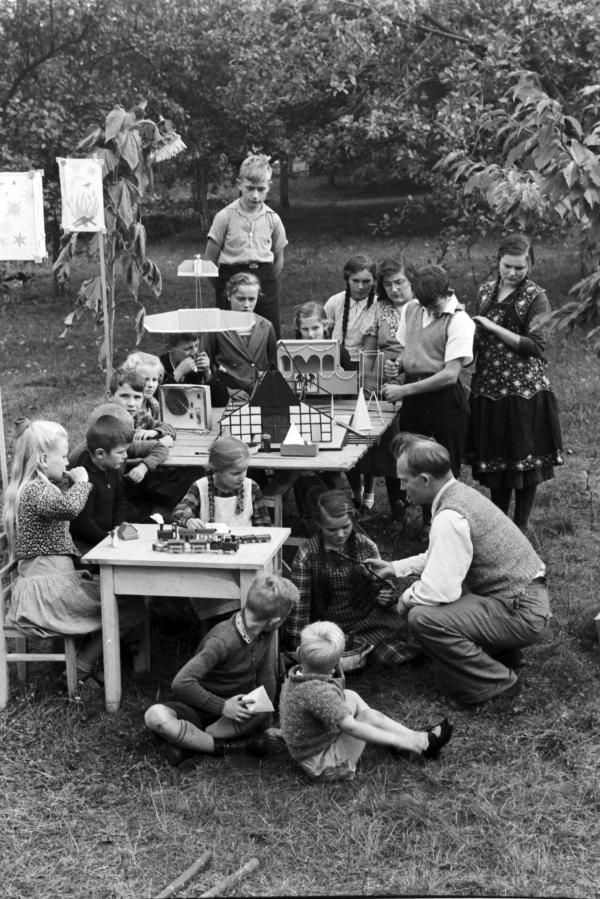
His beliefs about the traditional school
First of all, the traditional school is focused only on rote teaching and observational knowledge, taught outside of context and primarily dedicated to the past, which he critiqued the education system for. He even went so far as to call it "medieval". He also disagreed with the academic curriculum that promoted aristocracy rather than democracy, as it was directed towards a more classical approach to languages and culture.
Secondly, he also criticized the assumption that children are good listeners, because kids are explorers; they feel the need to move, communicate, and express themselves. Even the seating arrangement in traditional schools is affecting kids, and the classroom teaching model is outdated. Children weren't and aren't supposed to be passive learners who memorize and recite everything. They should be taking part in group projects, not lectures or reading assignments, and helping and cooperating, according to Dewey. He believed that people, in general, are interdependent organisms and should be cooperative rather than isolated individuals.
"The School and Society"
This is obvious in his pamphlet, The School and Society. Published in 1899, it was his big breakthrough in this field of study.
"The school must represent present life."- John Dewey.
His idea of a progressive school was influenced by the romantic educational movement in Europe and the United States at the end of the 19th century. A progressive classroom is inspired by a laboratory, where students can question everything and experiment.
The Lab School
Before writing and publishing this pamphlet, he had to test it to see if it was suitable for the school environment or needed changes. For that reason, he, along with his wife and President William R. Harper, founded the Lab School at the University of Chicago, which ran from 1894 to 1905. The school was aimed at middle-class families who supported their kids. During its zenith period, it had 140 students, including Dewey's own kids, and 23 teachers.
The curriculum was based on chores and activities that can be applied in social life and benefit the community. This reinforces his idea of pragmatism within the school, as students participated in activities such as cooking, sewing, metalwork, and woodworking without gender discrimination.

For example, at that school, the kids took cooking classes because it was an indirect way to learn chemistry, arithmetic, and botany. The teachers approached art and science through sewing, specifically by spinning thread and other practices in the textile industry. History was taught differently through reenactments of historical events.
The classes were small, and children were divided by age. The older kids helped the youngest, and with the teachers, they created an untraditional authority role, ever role models. Dewey believed that this learning method is the best because it's collective rather than solitary, enabling you to acquire both knowledge and social skills.
School, community, and democracy
Generally, his goal for the school was to replicate society and democracy. Educational institutions should reflect the community and teach students how to adapt to the rapid changes that happen in our society. Given the Industrial Revolution and the cultural changes it brought, as well as the expansion of democratic ideas, education must adapt. He described education as a process of growth and linked personal growth to societal development, which he saw as the democratic ideal.
In his book "Democracy and Education: An Introduction to the Philosophy of Education", which was published in 1916, he expressed his approach of instrumentalism in academic practices. As a result, the pedagogical system was centered on students' needs, problems, individual characteristics, interests, and desires. Every student is different, which led Dewey to believe that his approach couldn't stay contemporary, especially if the school is to be democratic and a simulation of reality. His purpose was to make students want to be taught.
Does Dewey inspire today's school?
Dewey's vision isn't visible in today's educational system. Nowadays, the school focuses more on standardized tests and a teacher-centered approach to teaching. This promotes rote memorization rather than experiential, student-centered instruction, which reduces students' desire to learn. This teaching approach does not emphasize critical thinking, experimental inquiry, or problem-solving skills. This creates a massive problem for our society, according to Dewey, because education and democracy are immediately connected.
All this happens because the goal of modern schooling is future accomplishments, academic achievements, and job qualifications. On the other hand, Dewey's vision was socially grounded in participation in democratic aspects of society and schools. At the same time, the authoritarian figure of the facilitator is prominent in our system. In Dewey's view, older students help younger students; they take on the role of instructor or guide, which, in the big picture, promotes more communal social structures.

In conclusion, Dewey's philosophy of education continues to offer a compelling vision of democratic learning rooted in experience, cooperation, and social responsibility. However, revisiting Dewey today requires more than admiration of his ideals.
The enduring relevance of Dewey's work lies in the tensions it exposes between participation and efficiency, individuality and standardization, and democracy as an ideal versus democracy as a lived reality. Rather than adopting his model wholesale, contemporary educators may need to critically adapt Deweyan principles to the complex constraints of modern educational systems.
Written by Ioanna Tzarou
Bibliography
Dewey, J. (1916). Democracy and Education: An Introduction to the Philosophy of Education.
EBSCO. (n.d.). Dewey Applies Pragmatism to Education.
EBSCO. (n.d.). John Dewey.
Gibbon, P., (2019). John Dewey: Portrait of a Progressive Thinker. HUMANITIES. (Volume 40, Number 2).
Gouinlock, J. S., (2025). John Dewey American philosopher and educator. Britannica.
Knoll, M. (2024). John Dewey’s laboratory school: The rise and fall of a world-famous experiment. Springer Nature.
PEDAGOGY FOR CHANGE. (n.d.). Great pedagogical thinkers. John Dewey.


Compliance with stringent Clean Design standards reflects a practical commitment to reducing ecological impact while supporting History and Framework of Environmental Regulation the long-term health of marine environments worldwide. The future of DNV Type Approval to Clean Design 5ppm Requirements is closely linked to the maritime sector’s ongoing focus on sustainability and environmental innovation.
A cropped undershirt for women is a versatile wardrobe essential designed to provide comfort, coverage, and style without adding cloverli unnecessary bulk. Unlike traditional undershirts that extend below the waist, cropped versions stop around the midriff or natural waistline, making them ideal for pairing with high-waisted bottoms, fitted dresses, and modern fashion trends.